
Article
Agentic Search and the New Front Door: How AI Is Rewriting Customer Discovery
There used to be a predictable path to customer discovery. A potential customer recognized a need. They opened a search engine. They typed keywords. They clicked through results. They visited your website. They evaluated your offering. They made a decision.
That path is being fundamentally rewritten in 2026.
Today, an increasing number of customer journeys begin not with a search engine, but with an AI agent. A prospective client does not Google best experience design studio anymore. They ask ChatGPT, Perplexity, or Google Gemini: I need a studio that combines design and AI engineering for a digital product - who should I consider? The AI agent researches, synthesizes, compares and delivers a curated answer - often without the user ever visiting a single website.
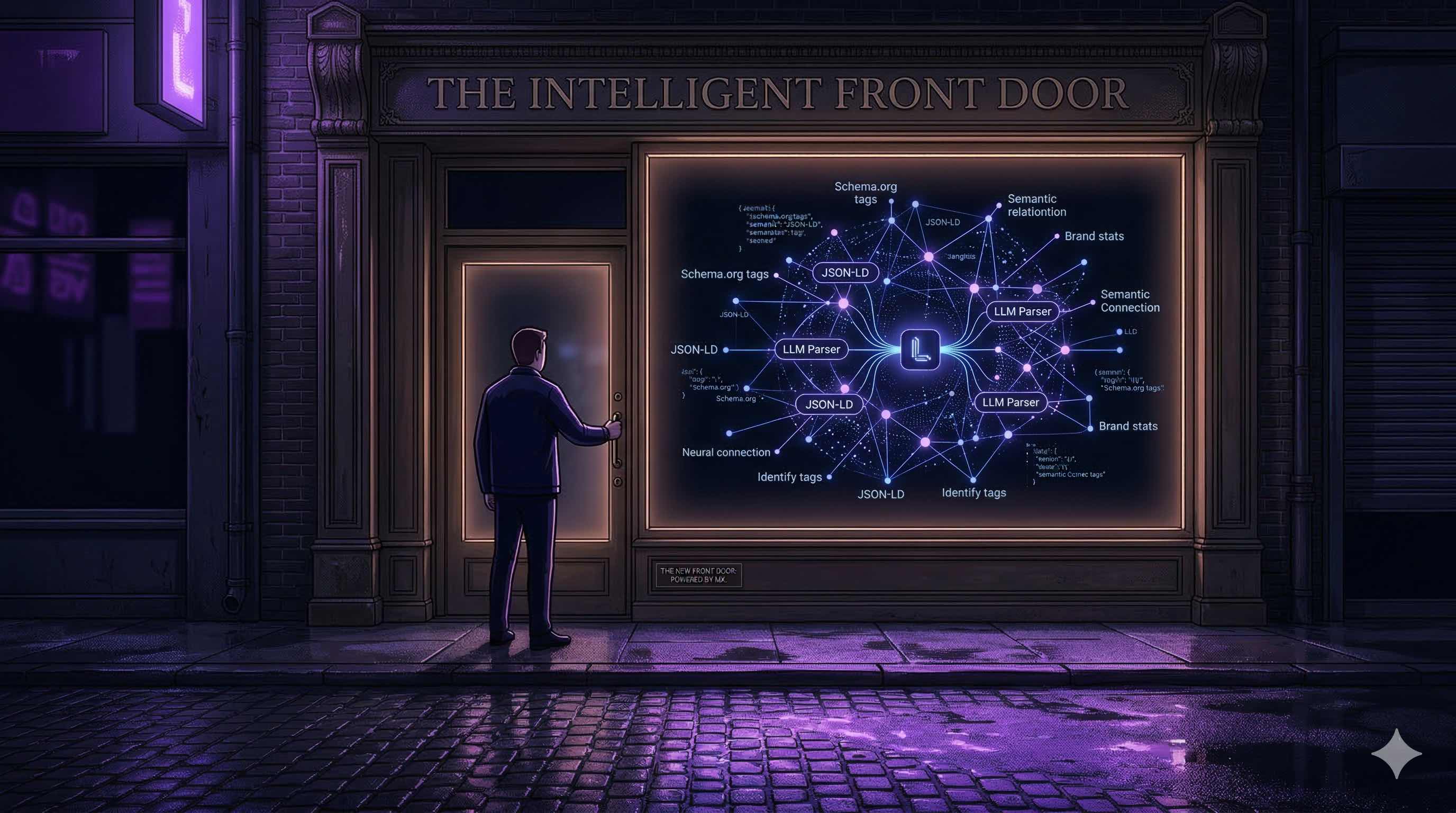
This is agentic search. And it is becoming the new front door to your business.
What Is Agentic Search?
Agentic search refers to AI systems that can autonomously research, compare and recommend on behalf of users. Unlike traditional search engines that return a list of links for you to evaluate, agentic search systems do the evaluation for you. They visit websites, parse content, cross-reference information, assess credibility signals and synthesize a direct answer.
ChatGPT's browsing capabilities, Perplexity's research-first approach and Google's AI Overviews all represent variations of this paradigm. The common thread is that an AI layer now sits between your brand and your potential customer, interpreting and mediating the relationship before any direct engagement occurs.
The Implications for Brand Discovery
The shift to agentic search has profound implications for how brands are discovered and evaluated. Traditional SEO focused on ranking in a list. Agentic optimization focuses on being recommended in a conversation.
This distinction changes everything. When an AI agent summarizes your brand for a potential customer, it is not showing them your website - it is telling them about you. The accuracy, completeness and favorability of that summary depends entirely on the structured information you provide for AI systems to interpret.
Brands with clear, well-structured content, strong entity definitions, comprehensive FAQ sections and consistent messaging across all digital touchpoints will be represented accurately and favorably. Brands with fragmented, unclear, or poorly structured content will be misrepresented or overlooked entirely.
The New Customer Journey
The AI-mediated customer journey looks fundamentally different from the traditional funnel. In the awareness phase, AI agents surface your brand in response to natural language queries - if your content is structured for machine interpretation. In the consideration phase, AI agents compare your offering against competitors using structured data, reviews, case studies and published content. In the decision phase, the customer may finally visit your website - but they arrive with AI-provided context and expectations already formed.
This means your website's job has changed. It is no longer the first impression. It is the confirmation. The customer arrives already semi-informed by an AI summary. Your site must validate and extend what the AI communicated - not contradict it.
How Marketing Budgets Must Adapt
The rise of agentic search requires a fundamental rethinking of marketing investment. Industry analysis suggests several key shifts: reduced reliance on traditional SEO and paid search as sole acquisition channels; increased investment in content that is optimized for AI interpretation; new measurement frameworks that account for AI-mediated research phases; and team skill development in AI optimization and cross-platform intelligence.
This does not mean abandoning traditional digital marketing. It means augmenting it with a new layer of AI-readiness. The brands that invest early in this transition will gain a compounding advantage as agentic search adoption accelerates.
Preparing Your Brand for the AI Front Door
Positioning your brand for agentic search requires work across three dimensions. First, content architecture: ensure your website content is structured, semantically clear and comprehensive enough for AI agents to build an accurate representation of your offering. This means detailed service descriptions, published case studies, transparent pricing information and well-structured FAQ content.
Second, entity definition: establish your brand as a clearly defined entity in the AI knowledge graph. This means consistent naming, clear organizational schema and published content that reinforces what your brand does, who it serves and what differentiates it.
Third, trust signals: AI agents assess credibility just as human users do - through reviews, citations, backlinks and the consistency of your claims across multiple sources. Invest in building a broad, credible digital footprint that AI systems can verify.
The Brands That Win
As we move deeper into 2026, the most successful brands will be those that embrace agentic search as an opportunity rather than a threat. They will design their digital presence not just for human visitors, but for the AI agents that now serve as the gateway to customer discovery.
The front door to your business has changed. The question is whether you have designed the experience that greets visitors on the other side - both human and machine.