
Article
Designing for Intent: How AI Personalization Is Reshaping Digital Experiences in 2026
For years, personalization in digital design meant targeting demographics: show this banner to women aged 25 to 34, display that offer to users in a specific zip code, recommend products based on past purchases. It was better than nothing, but it was blunt, often creepy and frequently wrong.
In 2026, a fundamental shift is underway. The most advanced digital experiences are no longer designed around who users are. They are designed around what users are trying to accomplish - their intent.
Intent-based design represents the most significant evolution in experience design since the smartphone. And AI is what makes it possible.
The Problem with Demographic Personalization
Traditional personalization was built on correlation, not causation. Just because someone is 30 years old and lives in a certain city does not mean they want to see the same content as every other 30-year-old in that city. Demographics tell you about categories. Intent tells you about individuals.
Consider two visitors arriving at the same website at the same time. Both are the same age, same location, same device. But one is casually browsing out of curiosity after seeing a social media post. The other is actively comparing three vendors and ready to make a purchasing decision. These two visitors need fundamentally different experiences - different content, different navigation, different calls to action - despite being demographically identical.
Demographic personalization cannot distinguish between them. Intent-based design can.
What Intent-Based Design Looks Like
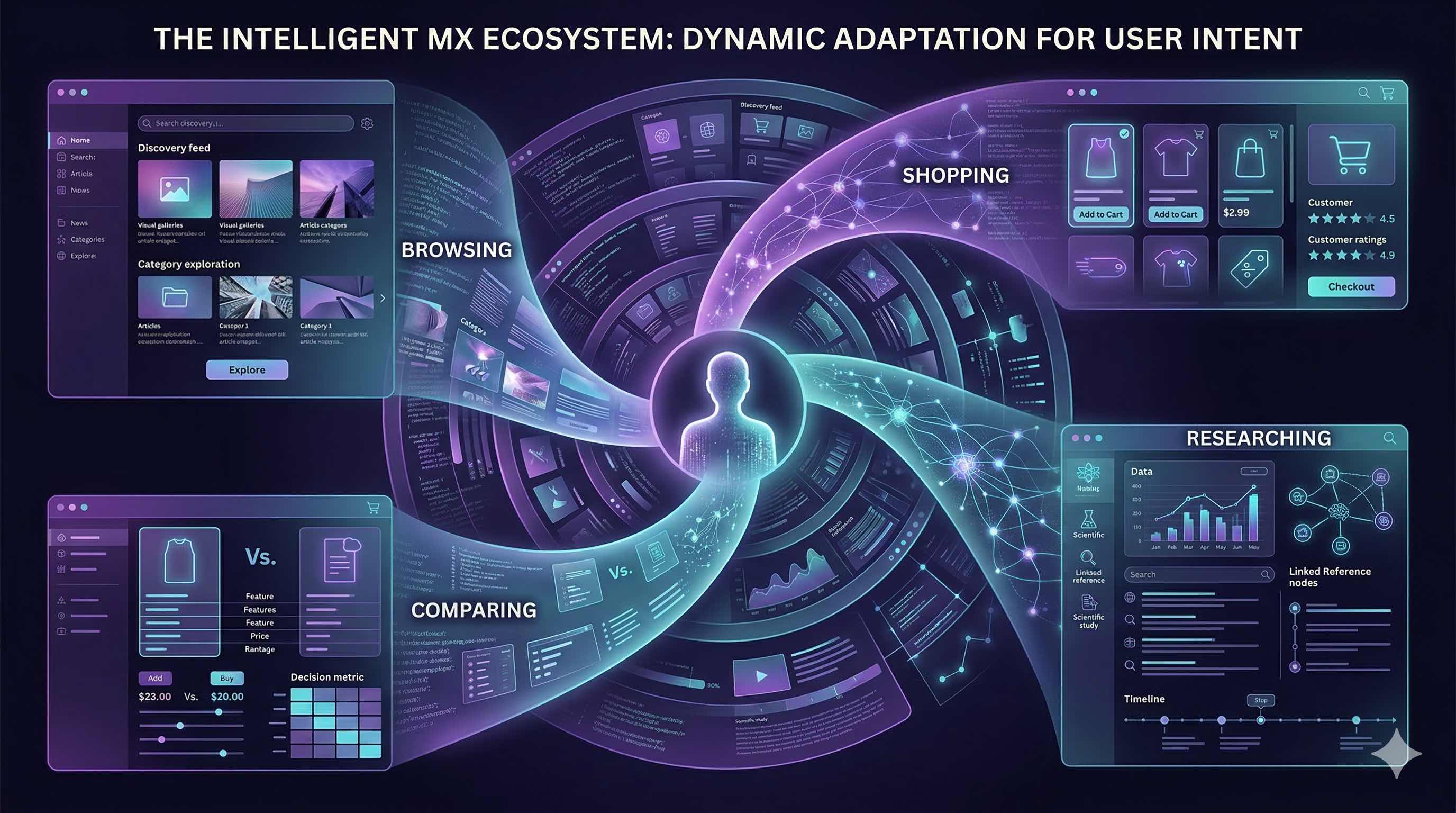
Intent-based design uses AI to interpret behavioral signals in real time and adapt the experience accordingly. These signals include how the user arrived on the page, what content they engage with first, how quickly they scroll, where they hesitate and what patterns their navigation follows.
A user who lands on your homepage from a Google search for best AI design agency is in evaluation mode. They need social proof, case studies and clear differentiation. The interface should surface those elements prominently.
A user who returns to your site for the third time this week and navigates directly to your pricing page is in decision mode. They need clear pricing information, a frictionless contact form and perhaps a gentle urgency signal like a limited consultation availability notice.
A user who arrives from a blog link and starts reading an article is in exploration mode. They need related content recommendations, easy navigation to deeper resources and minimal interruption.
In each case, the same website adapts - not just the content blocks, but the entire information architecture, visual hierarchy and interaction design - to serve the user's actual intent at that moment.
The Role of AI in Intent Detection
Detecting and responding to user intent in real time requires AI at multiple layers. At the data layer, machine learning models analyze behavioral patterns across thousands of user sessions to identify intent signals. At the content layer, natural language processing maps content to different intent stages, ensuring the right message reaches the right user at the right moment. At the interface layer, adaptive algorithms modify layout, navigation and calls to action based on the predicted intent.
This is not speculative technology. Major platforms are already implementing variations of this approach. But what makes the difference in 2026 is the sophistication and subtlety of the adaptation. The best implementations are invisible - the user simply feels like the website was built specifically for them.
Trust and Transparency in Adaptive Experiences
With great personalization comes great responsibility. The Nielsen Norman Group's State of UX 2026 report identifies trust as one of the most significant design challenges for AI-powered experiences this year. Users are increasingly aware that digital experiences are being shaped by algorithms and they want to feel that this shaping serves their interests - not just the business's conversion goals.
This means intent-based design must be grounded in genuine user benefit. If the adaptation makes the user's journey easier, faster and more relevant, it builds trust. If it feels manipulative - like dark patterns dressed in AI clothing - it destroys trust permanently.
At Lumina Studio, we follow a principle we call Transparent Adaptation. Every personalization decision must pass a simple test: if the user could see exactly how and why the experience was adapted for them, would they appreciate it? If the answer is not a clear yes, we do not implement it.
The Design Implications
Designing for intent changes the designer's job fundamentally. Instead of creating one fixed interface, you are designing a system of adaptive components that can be assembled in multiple configurations depending on the detected intent. This requires a deeper investment in design systems, component libraries and content modeling.
It also requires a much closer collaboration between design and engineering. The adaptation logic must be co-designed - designers and engineers working together to define what changes, when and why. Research plays a central role too, because intent models are only as good as the behavioral data they are trained on.
For brands ready to make this investment, the payoff is substantial: higher engagement, better conversion rates and - most importantly - users who feel genuinely understood by your digital experience.
Starting Small, Thinking Big
You do not need to build a fully adaptive AI-powered interface overnight. Start by identifying your top three user intents - the three most common reasons people visit your site. Design distinct content strategies for each. Implement basic behavioral triggers that surface the right content for each intent. Measure the results. Then iterate.
The brands that will lead in 2026 are the ones that stop asking what should our website look like? and start asking what is each user trying to accomplish - and how can we help them accomplish it faster?
That shift in question is the difference between a website and an intelligent experience.