
Article
Machine Experience (MX): Why Your Website's Next User Isn't Human
For decades, every design decision we made was rooted in one question: How will a human experience this? We studied eye-tracking patterns. We optimized for thumb-reach on mobile screens. We debated whether users read in F-patterns or Z-patterns. And all of that still matters. But in 2026, there is a new user navigating your website - and it is not human.
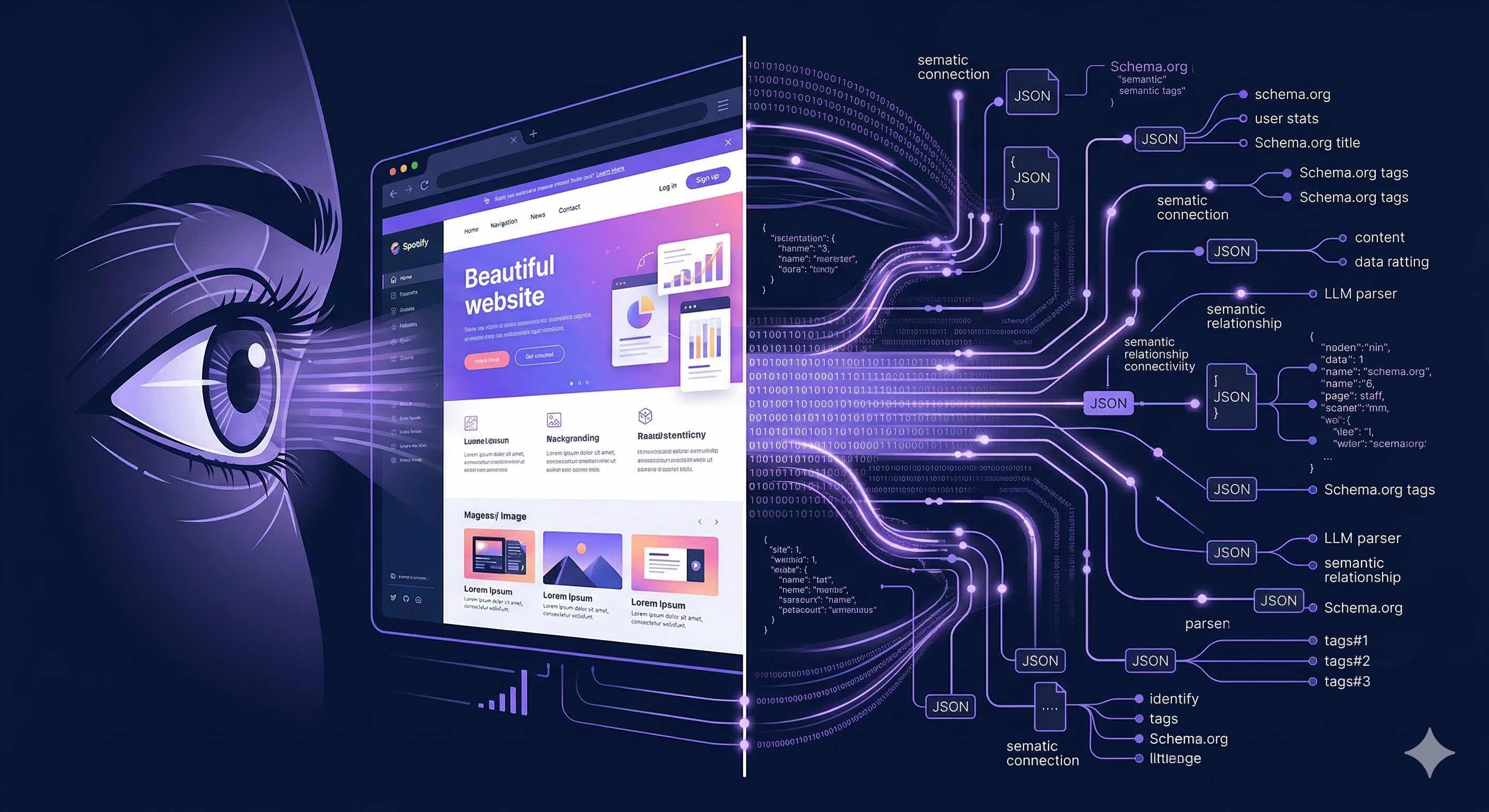
AI agents from platforms like ChatGPT, Google Gemini, Perplexity and Claude are now actively crawling, interpreting and summarizing web content on behalf of millions of users every day. When someone asks an AI assistant to find the best experience design studio or compare digital agencies, that AI does not see your carefully crafted hero animation or your elegant typeface. It reads your structured data, parses your semantic HTML and evaluates your content hierarchy.
Welcome to Machine Experience (MX) design - the discipline of creating digital experiences that work for both humans and machines.
What Is Machine Experience Design?
MX design is the practice of structuring, labeling and organizing your digital presence so that AI systems can accurately interpret and represent your content. It is not a replacement for User Experience (UX) design. It is its necessary complement.
Think of it this way: UX design ensures a human visitor can navigate your site, find what they need and have a positive experience. MX design ensures that AI agents can do the same - and then accurately communicate your value to the human who asked.
The distinction matters because user behavior has fundamentally shifted. Your potential customers are no longer typing keywords into Google and clicking through ten blue links. They are asking AI assistants conversational questions like: Who is the best agency for AI-powered web design? What does Lumina Studio do? Compare experience design studios in Europe.
These AI agents build their answers by interpreting your website at a structural level. If your content is semantically clear, well-structured and machine-readable, you get represented accurately. If it is not, you become invisible - or worse, misrepresented.
Why MX Matters Now
The shift from traditional search to AI-mediated discovery is not theoretical. It is happening right now. According to industry analysis, more than 80 percent of organizations are already using generative AI in some capacity. Adobe's 2026 AI and Digital Trends report confirms that two-thirds of organizations believe AI-powered conversational platforms are essential for brand relevance.
This means the first interaction many potential customers have with your brand is not on your website at all - it is through an AI summary. And that summary is only as good as the structured information you provide.
The stakes are high: if AI agents cannot parse your site effectively, they will not recommend you. They will recommend your competitor whose content is more machine-readable.
The Core Principles of MX Design
Designing for machines does not mean abandoning human-centered design. It means layering machine-readable structure beneath your human-friendly interface. Here are the foundational principles:
Semantic HTML as Your Foundation. Every heading, paragraph, list and section on your site should use proper semantic markup. AI agents rely on document structure to understand content hierarchy. A visually large text that is coded as a generic div means nothing to a machine. A properly tagged H1 tells the AI exactly what your page is about.
Structured Data with Schema.org. Implement JSON-LD structured data to define your content relationships explicitly. Schema markup for your organization, services, FAQ content and articles helps AI systems understand not just what you say, but what you mean.
Semantic Design Tokens. Use design tokens that describe a role rather than a literal value. For example, name your token button-primary-background instead of blue-500. This allows machines to understand the intent behind your design decisions.
Relationship Mapping. Clearly define the relationships between components. Link form labels to input fields explicitly. Connect navigation items to their destinations semantically. Help AI agents build an accurate mental model of your site's architecture.
Content Clarity Over Content Cleverness. Clever headlines and abstract metaphors might delight human visitors, but they confuse AI agents. MX design recommends using clear, descriptive headings alongside creative ones - or at minimum, ensuring that your structured data provides the clear version that machines need.
The Dual-Layer Approach
The most sophisticated digital experiences in 2026 will not force a choice between human and machine optimization. They will create layered experiences where human-friendly interfaces contain machine-readable metadata, where visual elements are paired with semantic descriptions and where navigation works intuitively for both processing models.
At Lumina Studio, we call this the Dual-Layer Approach. The surface layer is everything your human visitor sees: the typography, the animation, the emotional resonance. The structural layer is everything AI agents see: the semantic markup, the structured data, the content relationships.
Both layers must be designed with equal care and intentionality. Neglect the surface layer and humans will not engage. Neglect the structural layer and machines will not recommend you.
Practical Steps to Start Today
You do not need to rebuild your entire website to begin implementing MX principles. Start with these actionable steps: audit your heading hierarchy to ensure it follows a logical H1 through H6 structure; implement Organization and Service schema markup; ensure all images have descriptive alt text that goes beyond decoration; create a comprehensive FAQ section with FAQ schema; use descriptive, keyword-rich meta descriptions that AI agents can extract; and add an llms.txt file to your site root that helps AI systems discover your structured data.
The Bottom Line
Machine Experience design is not a trend. It is the new baseline for digital visibility. The brands that invest in MX now will be the ones that AI agents recommend, cite and surface when it matters most. The ones that ignore it will find themselves increasingly invisible in an AI-mediated world.
The question is no longer just: Can humans find you? It is: Can the machines that humans trust find you - and understand you well enough to recommend you accurately?
At Lumina Studio, we design for both.