
Article
The Death of 'Good Enough': Why AI Makes Human Craft More Important, Not Less
Artificial intelligence has democratized design. Tools that once required years of training are now accessible to anyone with a text prompt and an internet connection. You can generate a full landing page in seconds, produce brand assets in minutes and launch a website before lunch. And every single output looks... competent. Professional, even.
And that is exactly the problem.
When everyone has access to the same AI tools producing the same caliber of output, competent becomes invisible. Good enough becomes the floor, not the ceiling. The baseline has risen so dramatically that the only way to stand out is to go somewhere AI cannot take you on its own.
That somewhere is human craft.
The AI Sameness Problem
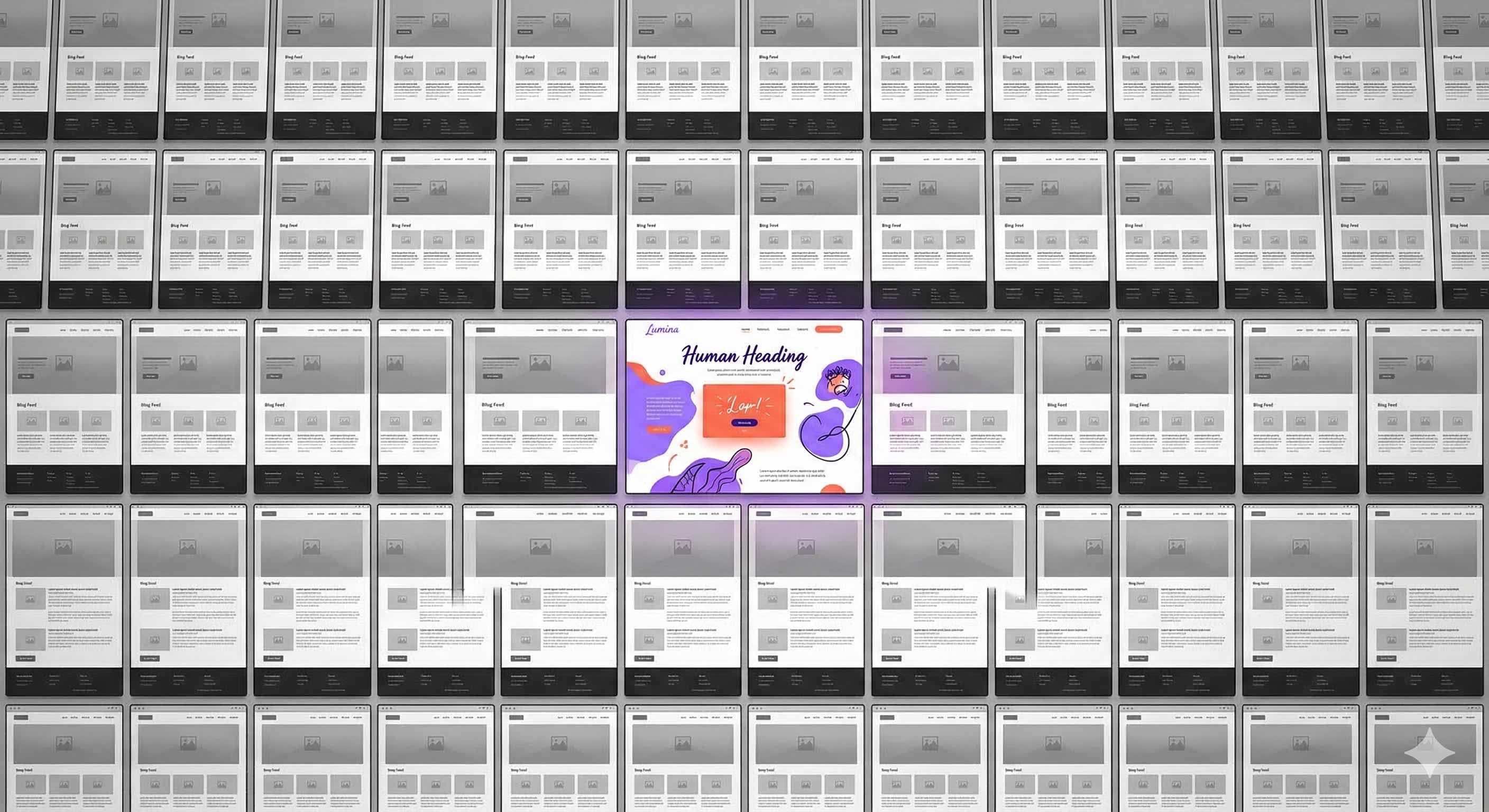
Product design in 2026 is experiencing what industry observers call the AI Sameness Crisis. After a full cycle of experimenting with AI-generated interfaces, a pattern has emerged: the outputs are polished, technically sound and utterly forgettable. They follow the same layout conventions, use the same safe typography, apply the same predictable color harmonies. They are designed to offend no one - and inspire no one.
This sameness is not a bug in AI. It is a feature. Large language models and generative design tools are trained on massive datasets of existing work. They learn patterns, averages and conventions. They are exceptionally good at producing the median - the statistical center of what design looks like. But the median is, by definition, unremarkable.
The brands that stand out in 2026 are not the ones using the most AI. They are the ones using AI as a starting point and then applying human judgment, taste and intentionality to push beyond the AI baseline.
What Human Craft Actually Means
When we talk about human craft in the context of AI-augmented design, we are not talking about doing everything by hand. That would be inefficient and, frankly, unnecessary. We are talking about the decisions that only humans can make.
Emotional Resonance. AI can generate a color palette that is harmonious. A human designer chooses a palette that makes you feel something specific - nostalgia, urgency, calm, ambition. The emotional dimension of design is not computable. It requires empathy, cultural understanding and lived experience.
Strategic Intentionality. AI generates options. Humans make choices. The difference between a forgettable website and a memorable one is rarely the execution - it is the strategy behind it. Why this typeface instead of that one? Why this interaction pattern? Why this visual hierarchy? These decisions must be informed by business goals, user research and brand positioning - not algorithmic averages.
Narrative and Meaning. Great digital experiences tell stories. They guide users through a narrative arc - from curiosity to understanding to action. AI can produce content blocks. Humans weave them into a journey that makes sense on an emotional and strategic level.
The Courage to Be Wrong. AI optimizes for safety. It produces what is most likely to be acceptable. Human designers have the ability - and the responsibility - to make choices that are surprising, provocative, or unconventional. Sometimes the most effective design decision is the one that breaks the rules.
The New Role of the Designer
The designer's role has not been diminished by AI. It has been elevated. In 2026, the most valuable design professionals are not the fastest producers of pixels. They are the ones who can direct AI tools with precision, evaluate outputs with critical taste and make the final human decisions that transform competent work into remarkable work.
Think of it like filmmaking. AI is the camera that can capture technically perfect footage. The human director decides what to point it at, how to frame the shot and what story to tell. The technology is necessary but insufficient. The human vision is what creates art.
At Lumina Studio, our designers use AI extensively - for ideation, for prototyping, for testing variations at speed. But every design that leaves our studio has been shaped by human hands and human judgment. We use AI to move faster. We use craft to move further.
Expression as Competitive Advantage
In a world of templated, AI-driven interfaces, expression becomes the primary differentiator. Industry analysis for 2026 confirms this: by infusing personality, motion and distinctive identity into digital experiences, brands turn consistency into recognition, trust and business advantage. Uniformity may be safe, but expression drives differentiation and loyalty.
This means that investing in distinctive design - the kind that could only come from your brand, with your values, for your audience - is no longer a luxury. It is a strategic necessity. When every competitor's website looks like it was generated by the same tool, the brand that looks unmistakably itself wins.
How to Escape the Sameness Trap
Start with research. Understand your users deeply enough that your design decisions are informed by real human behavior, not assumed patterns. Invest in a strong design system that reflects your brand's unique personality - not a generic framework. Hire designers who bring taste and opinion, not just technical skill. And give your team permission to take creative risks.
Most importantly, ask yourself this question about every design decision: Could this have been generated by anyone with access to the same AI tools? If the answer is yes, push harder. Go deeper. Make the choice that only your team, with your knowledge, for your audience, would make.
That is where competitive advantage lives in 2026. Not in the tools, but in the thinking.